Early Morning on Congress Avenue: A City Braced for Disruption
At 3 a.m. on Sunday, February 15, 2026, the normally bustling intersection of Congress Avenue and East Cesar Chavez Street in downtown Austin will fall eerily silent. The neighborhood around this key junction, a vital artery connecting residents from the urban core to the east side, will face its first wave of road closures as the city prepares for the Ascension Seton Austin Marathon. By dawn, the streets that usually carry commuters, delivery trucks, and emergency vehicles will be locked down, setting the stage for a day of major traffic upheaval.
What’s Happening: Road Closures and Race Details
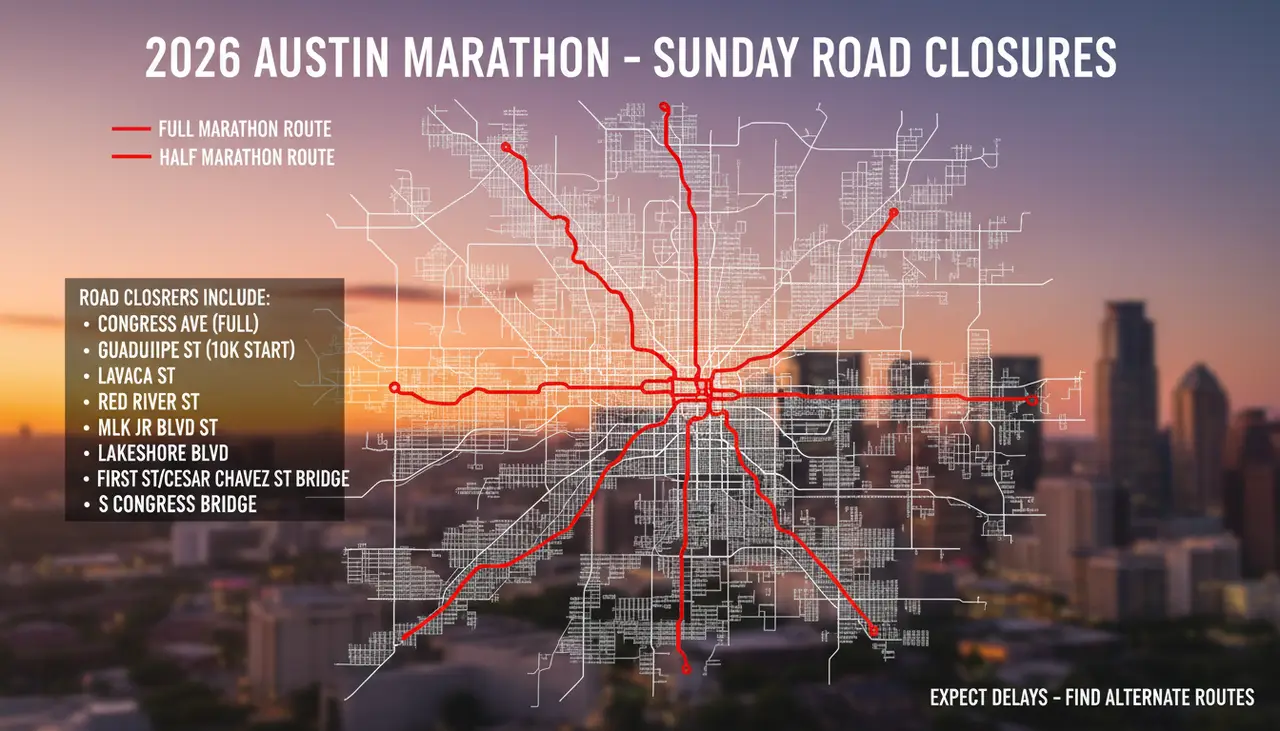
The Austin Marathon and its associated races kick off at 7 a.m. from Congress Avenue and East Cesar Chavez Street, with a 26.2-mile course ending at Congress and Ninth Street. The event draws approximately 30,000 runners and an estimated 100,000 spectators, turning wide swaths of Austin’s central neighborhoods into a no-go zone for vehicles.
Road closures begin as early as 3 a.m. at the starting point of Congress and Cesar Chavez, reopening only at 10 a.m. Along the marathon route, closures extend progressively, with key intersections like South Congress and Gibson closing at 5 a.m., and cross streets shutting down as late as 9 a.m. The final closures on the course, including the intersection of 11th Street and San Jacinto Boulevard at mile 26, will not reopen until 2:30 p.m.
These staggered closures cover major corridors including South Congress Avenue, South First Street, Lamar Boulevard, Guadalupe Street, and East Cesar Chavez Street. Friday and Saturday will also see significant restrictions, with parts of Congress Avenue closed from 9 a.m. Friday through Saturday afternoon, affecting Ninth Street and other central downtown streets.
Why This Matters to Austin Residents
These closures will severely disrupt daily routines across multiple neighborhoods. If you live or work near Congress Avenue, East Cesar Chavez, South First, or Lamar Boulevard, expect major delays that could ripple through your entire day.
Safety is a critical concern. Emergency vehicles will face detours, and residents unfamiliar with the closure times risk being trapped in or out of their neighborhoods. The staggered reopening times—some as late as mid-afternoon—mean that even if you plan to leave early, you could be stuck behind barricades.
Financially, the closures could impact local businesses dependent on foot and vehicle traffic. Delivery delays and missed appointments are likely, as are increased costs for ride services and alternative transportation. The stress of navigating around closures and finding parking will add to the burden, particularly for households juggling work and family obligations.
Ignoring these closures or underestimating their impact can lead to lost wages, missed medical appointments, and even safety hazards if emergency routes are blocked. The marathon’s scale means these are not isolated disruptions—they affect large swaths of central Austin simultaneously.
If You’re Affected: What To Do Immediately
- Check your route before leaving home. Use official resources like youraustinmarathon.com/traffic for real-time updates.
- Plan to leave earlier than usual. Roads start closing as early as 3 a.m., and some won’t reopen until mid-afternoon.
- Avoid driving through closed intersections. Barricades will be enforced, and attempting to bypass them could result in fines or vehicle damage.
- Notify your employer or clients if you anticipate delays. Adjust work hours or remote work plans where possible.
- Use public transit or alternate routes well outside the marathon zone. Streets like Second, Third, Fourth, Fifth, Sixth, and Seventh remain open on Saturday but may face heavy traffic Sunday.
- If you require emergency services, call ahead to understand how closures might affect response times in your area.
- Have a backup plan for childcare, medical appointments, and deliveries, as access to your neighborhood could be limited.
When Professional Help Becomes Necessary
If the marathon closures cause property damage—such as vehicles getting blocked in or accidents due to detours—you need to contact legal professionals immediately to understand your rights and next steps.
Residents and businesses impacted by delivery delays or property access issues may require contractors or repair services, especially if emergency repairs become urgent but access is hindered by closures.
For anyone managing property or planning events around the marathon, consulting with planners familiar with Austin’s closure schedules is critical to avoid costly disruptions.
Finally, if you experience damage or disruption related to road closures and barricades, professional legal advice is essential to navigate claims or disputes with event organizers or city agencies.
Local Context: Daily Life Meets Marathon Disruption
Congress Avenue and East Cesar Chavez Street are more than just race landmarks—they are daily conduits for thousands of Austin residents. From downtown workers heading to offices near the Capitol to families living in East Austin, these closures will cut through well-trodden paths. Lamar Boulevard and South First Street are major commuter routes, meaning many will face detours that add significant time to their travel.
For residents in neighborhoods like Bouldin Creek, Travis Heights, and parts of the University of Texas area, the marathon’s footprint is unavoidable. Whether you’re picking up groceries, attending medical appointments, or simply trying to get your kids to school, the closures demand your full attention and preparation.
Where This Is Happening in Austin
The marathon route threads through some of Austin’s most trafficked streets and neighborhoods. Starting at Congress Avenue and East Cesar Chavez Street, the course moves along South Congress Avenue, crossing intersections at Gibson Street, Oltorf Street, and Ben White Boulevard.
It continues up South First Street, passing Lightsey Road, West Mary Street, and Riverside Drive. The route then shifts to West Cesar Chavez Street and Lamar Boulevard before heading toward the University area along 15th Street and Guadalupe Street.
Further north, closures affect Red River Street, Duval Street, East Dean Keeton Street, and Chicon Street. The path moves east through neighborhoods near North Pleasant Valley Road and Webberville Road, closing roads as far out as Tillery Street, Goodwin Avenue, and Allen Street.
The marathon finishes near Ninth Street and Congress Avenue, with final closures extending to 11th Street and San Jacinto Boulevard. Landmarks along the route include the Texas State Capitol area, the University of Texas campus, and the vibrant East Austin neighborhoods.
Local residents routinely use these streets for commuting, errands, and leisure. The scale and timing of closures will require significant adjustments for anyone living, working, or traveling through central Austin on February 15.